Targets Iran’s ballistic missiles can and will strike in Europe as war with US, Israel expands
In its recent official statements, the Israel Foreign Ministry warned that Iran’s ballistic capability “spans beyond the Middle East.” It referred to the Iranian regime as a growing threat to world peace.
The spectre of war in the Middle East has taken a sharp, unsettling turn. What began as targeted strikes between the United States and Israel against Iranian military infrastructure has spiraled into one of the most serious geopolitical crises in recent decades — with implications that extend well beyond the region. Among the most alarming developments is the assertion, amplified by Israeli and Western officials, that Iran’s ballistic missiles have the capability to strike targets deep into Europe.
In its recent official statements, the Israeli Foreign Ministry warned that Iran’s ballistic capability “spans beyond the Middle East.” It referred to the Iranian regime as a growing threat to world peace.
Advertisement
Iran’s ballistic capability spans beyond the Middle East. The Iranian Ayatollah regime is threatening world peace. pic.twitter.com/VKTAmf3Qaq
Advertisement
— Israel Foreign Ministry (@IsraelMFA) March 2, 2026
Inside Iran’s ballistic & cruise missiles
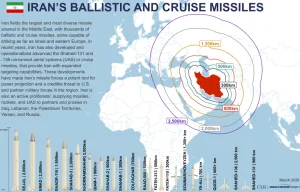
Iran possesses the largest and most diverse missile arsenal in the Middle East, with thousands of ballistic and cruise missiles capable of striking targets far beyond its borders, including Israel and parts of eastern Europe, according to recent assessments.
A detailed graphic released by the Center for Strategic and International Studies (CSIS) Missile Defense Project outlines the breadth of Tehran’s capabilities, mapping concentric strike ranges extending from 300 kilometres to as far as 2,500 kilometres. The outermost range places significant portions of southeastern Europe within potential reach.
Expanding range and capability
At the lower end of the spectrum are short-range systems such as the Fateh-110 and Shahab-1, with ranges of approximately 300 kilometres. Medium-range platforms, including the Shahab-3 and Ghadr-110, extend reach to roughly 2,000 kilometres. Longer-range systems such as the Sejjil are assessed to be capable of striking targets up to 2,000 kilometres away.
Cruise missile and unmanned aerial system (UAS) developments have further enhanced Iran’s strike options. Systems such as the Soumar and Hoveizeh cruise missiles are estimated to have ranges exceeding 1,300 kilometres. Meanwhile, the Shahed-131 and Shahed-136 drones offer strike ranges of roughly 900 kilometres and 2,500 kilometres, respectively.
What does this signal for Europe?
Iranian ballistic missiles pose a threat to several cities in Europe, according to the infographic map released by Israel’s Ministry of Foreign Affairs. The map suggests that parts of the Mediterranean basin and areas of central Europe could be among the potential targets.
The map illustrates the reach of Iran through three distinct concentric arcs radiating from the center of Iran, which suggests a tiered capability where different missile classes are capable of targeting varying depths of territory.
European countries that are actively helping the US and Israel launch attacks on Iran might be places of high interest for Tehran’s strikes.
While some European cities lie well outside the range of Iran’s ballistic missiles, others are positioned closer and could fall within striking distance depending on the missile class deployed.
Targets within striking power of Iran’s missiles
The eastern Mediterranean appears most exposed. Portions of the Balkans and southeastern Europe seem to be within reach of the Iranians according to Israel’s Foreign Affairs Ministry. Capitals such as Athens (Greece), Sofia (Bulgaria), and Bucharest (Romania) fall within the projected radius.
Tensions escalated further after a drone strike reportedly hit a British base near Limassol in Cyprus. Cyprus, holder of the European Union’s rotating presidency, had to insist that it was not involved in the conflict after a Shahed-type drone damaged the UK air base on the island’s southern coast over the weekend.
Beyond the Mediterranean, parts of central and eastern Europe are also shown within the extended range arc, though distance may reduce practical feasibility. Cities such as Budapest (Hungary), Vienna (Austria), Warsaw (Poland), and Bratislava (Slovakia) appear within the broader theoretical coverage zone.
It is important to underline that the illustrated potential range reflects technical potential rather than confirmed military plans. Missile reach alone does not determine operational intent, strategic decision-making, or strike accuracy.
The United States Central Command carried out the strikes over the weekend against radar systems and drone command-and-control infrastructure located in Goruk, Iran, and on Qeshm Island.
The US Department of State announced sanctions against multiple entities spread across Qatar, Singapore, Hong Kong, the United Arab Emirates and the Marshall Islands, alleging their involvement in Iran’s so-called “shadow oil economy”.
Fresh US strikes inside Iran and explosions near Bandar Abbas have renewed tensions as Donald Trump warned Tehran that Washington could escalate further if talks collapse.